
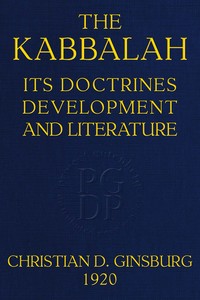
The Kabbalah: its doctrines, development, and literature by Christian D. Ginsburg
Let's be clear from the start: this isn't a 'how-to' guide for mystical practices. Christian Ginsburg's book is something else entirely. It's a deep, scholarly look at Kabbalah, written in 1865, that tries to trace its real history and core ideas.
The Story
Ginsburg doesn't tell a story with characters, but he does follow a compelling intellectual trail. He starts by asking basic questions: What is Kabbalah, really? Where did it come from? He then walks us through its key texts, like the Zohar, explaining their strange and symbolic language. A huge part of the book is dedicated to a historical debate. Many people in Ginsburg's day (and still today) believed Kabbalah was an incredibly ancient, secret doctrine. Ginsburg, using his research, argues that it actually developed much later, during the Middle Ages. The book is his evidence-filled case for that argument. He explains the big ideas—like the Ten Sefirot (which are like aspects of God's energy) and the concept of Tikkun (repairing the world)—but always ties them back to their historical context.
Why You Should Read It
I loved this book because it cuts through the noise. In a world full of quick, modern takes on spirituality, here's a writer from the 1800s doing the hard work of source-checking. His passion is obvious; he's not a dry academic, but someone trying to set the record straight. You get a real sense of the 'detective work' of history. Reading it, you start to see how religious and philosophical ideas evolve, how legends form around them, and how important it is to ask, "What's the actual evidence?" It makes you think differently about all sorts of beliefs.
Final Verdict
This book is a perfect fit for a specific kind of reader. If you're a history or religion nerd who loves primary sources and intellectual debates, you'll eat this up. It's also great for anyone genuinely curious about Jewish mysticism but tired of the watered-down, commercial versions. A word of warning: it's an old, dense text. It requires some patience. But if you're willing to put in the effort, it's incredibly rewarding. Think of it less as a casual read and more as a guided tour through a complex and often misunderstood tradition, led by a dedicated and opinionated guide.
Legal analysis indicates this work is in the public domain. Feel free to use it for personal or commercial purposes.
Richard King
4 months agoWow.
Donald Scott
1 year agoGreat read!
John Perez
1 year agoI didn't expect much, but the content flows smoothly from one chapter to the next. Absolutely essential reading.
Oliver Nguyen
2 months agoI was skeptical at first, but the narrative structure is incredibly compelling. I will read more from this author.
Noah Harris
1 year agoEssential reading for students of this field.